Top 8 Sales Forecasting Methods To Predict Revenue

What is sales forecasting?
Sales forecasting methods offer valuable insights into future revenue streams and help companies anticipate changes in market conditions. By accurately predicting sales outcomes, businesses can make informed decisions that optimize resource allocation, improve inventory management, and ensure they are prepared to meet customer demand. This proactive approach enables businesses to fine-tune their operations, adjust marketing strategies, and align their teams toward common goals. Beyond short-term objectives, sales forecasting plays a key role in shaping long-term business strategies, allowing companies to stay agile in a dynamic market environment, mitigate risks, and seize growth opportunities. Ultimately, effective sales forecasting methods empower businesses to move forward with confidence, backed by data-driven insights that foster informed decision-making at all levels.
Definition of sales forecasting
At its core, sales forecasting is the process of estimating future sales over a defined period. This involves analyzing historical sales data, monitoring current market trends, and incorporating predictive analytics to anticipate performance. Accurate sales forecasts empower organizations to optimize production, improve budgeting, and enhance overall business efficiency. It’s a proactive approach to staying ahead in a competitive market.
What are sales forecasting methods?
Sales forecasting methods are the systematic approaches businesses use to predict sales outcomes. These methods typically fall into two main categories: qualitative and quantitative. Qualitative methods rely on subjective inputs like expert opinions and customer feedback, while quantitative methods analyze numerical data using statistical models. Each sales forecasting method is designed to suit specific scenarios, from assessing market trends to evaluating internal performance metrics. Businesses often combine multiple methods to ensure robust, reliable predictions.
Why is sales forecasting important?
Accurate sales forecasting methods are critical for several reasons. Firstly, it helps businesses allocate resources efficiently, ensuring that staffing, inventory, and marketing budgets align with expected demand. Secondly, it allows organizations to identify potential risks, such as seasonal dips or economic shifts, and proactively mitigate their impact. Accurate sales forecasts also improve stakeholder confidence, demonstrating a company’s ability to meet revenue goals. Most importantly, sales forecasting empowers businesses to make strategic decisions with clarity and foresight, driving sustainable growth and profitability.
What are the different types of sales forecasting?
Sales forecasting methods can be broadly categorized into two primary types: qualitative and quantitative. Each of these forecasting types offers distinct advantages, and businesses typically choose the method based on available data, industry requirements, and specific goals for forecasting. Understanding the strengths of each type is essential for businesses aiming to create accurate, actionable predictions.
Qualitative Sales Forecasting
Qualitative sales forecasting is a method that depends largely on expert insights, market research, and subjective evaluations. These techniques are especially valuable when historical data is sparse or market conditions are unpredictable and volatile. By incorporating expert opinions and consumer feedback, businesses can make well-rounded predictions about future sales trends, even in the absence of extensive past data. This method leverages human judgment and intuition to address factors that may not be fully quantifiable, such as changing consumer preferences or the potential impact of new competitors.
Expert Opinion
Expert opinion is one of the most widely used qualitative sales forecasting methods. It involves gathering insights from experienced professionals, either within the organization or from external experts, who have deep knowledge of the industry, market conditions, and consumer behavior. Experts may offer their forecasts based on their experience, intuition, and understanding of the market dynamics. To ensure that the predictions are accurate and consistent, structured techniques, such as interviews, panel discussions, or surveys, are often used to collect and evaluate expert opinions. This method provides valuable insights, particularly when forecasting in complex or rapidly changing markets.
Delphi Method
The Delphi method is a systematic approach for gathering expert opinions, typically involving multiple rounds of feedback from a panel of experts. In each round, experts provide their individual forecasts anonymously, reducing the potential for bias. After each round, the facilitator aggregates the feedback, shares it with the panel, and allows experts to revise their forecasts based on the information provided by others. Through iterative rounds of feedback and revisions, the group arrives at a consensus on the sales forecast. This method is particularly effective in minimizing individual biases, leveraging collective wisdom, and ensuring that all perspectives are considered when formulating predictions.
Panel Consensus
Panel consensus is a more interactive and collaborative qualitative sales forecasting method. In this approach, experts come together in a group setting to openly discuss their opinions, insights, and forecasts. Through dialogue and discussion, the group refines and adjusts the sales forecast, with the goal of reaching a mutual agreement. The benefits of panel consensus include dynamic interaction among experts, which can lead to a more comprehensive and well-rounded forecast. However, this method can sometimes be influenced by dominant voices or group dynamics, making it essential to maintain a balanced and open discussion to ensure that all opinions are considered equally.
Market Research
Market research is a crucial method for gathering data directly from consumers to better understand their purchasing behaviors, preferences, and potential demand. This type of forecasting is particularly useful when businesses are launching new products or exploring untapped markets. By conducting market research, businesses can identify trends, estimate demand, and anticipate market reactions with a higher degree of accuracy. Market research allows companies to gather firsthand insights into what consumers want, how much they are willing to pay, and what factors influence their purchasing decisions.
Customer Surveys
Customer surveys are a common tool used in market research to collect valuable data directly from the target audience. These surveys typically ask questions about purchase intent, product preferences, pricing sensitivity, and key features that influence buying decisions. By analyzing the responses, businesses can gauge the likelihood of sales success and forecast demand for new or existing products. Surveys can be distributed online, through email, or via phone to ensure a broad and representative sample of the customer base.
Focus Groups
Focus groups are small, diverse groups of consumers brought together to discuss their opinions, attitudes, and perceptions about a product or service. These moderated discussions provide deeper insights into consumer behavior, as participants are encouraged to share their thoughts and experiences in a group setting. Focus groups are especially useful for exploring consumer reactions to new products or services, refining marketing strategies, and assessing potential demand. The qualitative feedback gained from focus groups can significantly enhance sales forecasting accuracy by providing a more nuanced understanding of consumer preferences.
Quantitative Sales Forecasting
Quantitative sales forecasting is based on numerical data and statistical techniques to predict future sales. This method is particularly effective for businesses with robust historical sales data and a stable market environment. Quantitative forecasting methods rely on established patterns and trends to make predictions about future sales performance, making them ideal for organizations that have a track record of consistent data. These methods provide objective, data-driven insights that can be tested and refined over time.
Trend Analysis
Trend analysis involves examining historical sales data to identify patterns and trends that can help predict future performance. By analyzing past sales data over a defined period, businesses can identify recurring patterns, such as seasonal fluctuations or cyclical changes, that offer clues about future sales behavior.
Regression Analysis
Regression analysis is a statistical technique used to evaluate the relationship between sales and other influencing variables, such as marketing expenditure, economic factors, or competitor actions. By identifying correlations between sales and external factors, businesses can gain a deeper understanding of what drives sales performance and make more accurate forecasts.
Time Series Analysis
Time series analysis involves studying sales data over a set period to detect recurring patterns or trends. This method is particularly effective for industries with predictable cycles, such as retail, tourism, or fashion, where sales often fluctuate due to seasonality or other temporal factors.
Causal Analysis
Causal analysis seeks to identify cause-and-effect relationships between sales and external factors, such as changes in market conditions, competitor activity, or macroeconomic trends. By understanding the underlying drivers of sales performance, businesses can make more accurate forecasts and better anticipate future outcomes.
What are the core sales forecasting models?
Sales forecasting models provide structured approaches to predicting future revenue by analyzing various data sets and external factors. These models vary in complexity and are selected based on the specific needs of the business, such as the type of data available or the industry in which the organization operates. Let’s explore the key sales forecasting models and their unique applications.
Trend Analysis
The core assumption behind this model is that past sales behaviours—whether marked by steady growth, cyclical fluctuations, or seasonal changes—will continue into the future. By identifying these patterns, businesses can gain insights into future sales trends and adjust their strategies accordingly. For example, a retailer with years of data might identify a consistent increase in sales during the holiday season, allowing them to prepare for higher demand and allocate resources accordingly.
Trend analysis is most effective when used in industries with low volatility and when the business can rely on historical data to draw meaningful conclusions. This model provides a valuable foundation for long-term planning, enabling organizations to forecast future revenue with greater accuracy. In addition, businesses can use trend analysis to identify potential market shifts that may affect demand and adjust their strategies, such as introducing new products or entering new markets to capitalize on emerging trends. By focusing on long-term performance, trend analysis helps businesses stay aligned with ongoing market dynamics, customer preferences, and economic conditions, ensuring they remain competitive.
Regression Analysis
This method involves evaluating how changes in one or more independent variables—such as marketing spend, economic conditions, consumer behavior, or competitor activity—affect dependent variables like sales revenue. For example, a company might use regression analysis to analyze how increasing its advertising budget impacts overall sales or how external economic factors, such as inflation or interest rates, influence consumer purchasing patterns.
Regression analysis allows businesses to isolate the effect of specific factors and assess their impact on sales. This helps organizations refine their forecasting models by considering multiple variables simultaneously, providing a more nuanced and accurate prediction of future sales outcomes. Companies in highly competitive or fast-changing industries often turn to regression analysis to forecast how shifts in market conditions or consumer behavior will influence sales. It is a powerful tool for decision-making, enabling businesses to optimize their resource allocation and sales strategies based on a deeper understanding of sales drivers.
Regression analysis is particularly valuable for businesses that operate in dynamic environments, where external factors can have a significant and measurable impact on sales performance. By continuously adjusting the regression model as new data becomes available, businesses can refine their forecasts and stay agile in responding to changes in the marketplace. This adaptability ensures that the sales forecasting methods remain relevant and reliable, even as external conditions evolve.
Time Series Analysis
This method is particularly useful for identifying predictable fluctuations in sales, such as seasonal variations, annual cycles, or other time-dependent factors that influence demand. By analyzing historical sales data on a time-based scale, businesses can detect seasonal peaks and troughs in demand, such as increased sales during the holiday season or downturns during off-peak periods. This insight enables organizations to better plan and allocate resources, such as staffing, inventory, and production schedules, to meet fluctuating customer demand.
By forecasting future sales trends based on historical data, businesses can develop targeted strategies to boost revenue during peak times while minimizing waste or underperformance during slower periods. For example, a clothing retailer may use time series analysis to forecast demand for specific types of clothing based on past sales data, allowing them to optimize inventory levels and ensure that popular items are in stock during the peak shopping seasons.
The ability to anticipate fluctuations in demand helps businesses avoid overstocking or understocking products, improving both operational efficiency and customer satisfaction. Time series analysis is also beneficial in reducing costs associated with last-minute decision-making, as businesses can plan in advance based on data-driven insights. By continuously monitoring sales trends and adjusting forecasts as needed, organizations can ensure that their operations remain agile and responsive to the changing needs of the market.
Causal Analysis
This approach goes beyond simply identifying patterns or correlations in historical sales data, focusing on understanding the underlying reasons behind sales fluctuations. Causal analysis examines how specific factors, such as changes in market trends, competitor actions, new product launches, or macroeconomic shifts, directly impact sales outcomes. For instance, a company might explore how a competitor’s aggressive pricing strategy influences its own sales performance or how an increase in consumer spending during an economic boom leads to higher demand for its products.
One of the key strengths of causal analysis is its ability to provide a deeper understanding of the drivers behind sales, allowing businesses to forecast how future changes in external conditions will affect their revenue. This makes it an invaluable tool for businesses operating in highly competitive or rapidly changing markets, where understanding the forces driving sales can be critical for long-term success. Causal analysis often requires more complex data collection and modelling techniques, as businesses need to gather detailed information on both sales performance and the factors that influence it. It also requires a solid understanding of the market dynamics, as businesses must identify the right causal factors to include in the analysis.
The insights gained from causal analysis allow businesses to proactively adapt their sales strategies based on a thorough understanding of what drives revenue. This method can also be used to test hypotheses about the impact of certain decisions or actions, helping organizations make more informed choices about pricing, marketing, and expansion strategies. While causal analysis may require more sophisticated tools and expertise, its ability to provide actionable, data-driven insights into sales performance makes it an essential part of the forecasting toolkit for businesses aiming to stay competitive in complex markets.
Judgmental Analysis
Judgmental analysis is a hybrid sales forecasting method that combines data-driven insights with the input of human experts to refine and improve the accuracy of forecasts. While quantitative models like regression and time series analysis rely on historical data and statistical techniques, judgmental analysis integrates expert intuition and experience to account for sudden changes, anomalies, or unique factors that may not be captured by historical data alone.
In judgmental analysis, businesses rely on expert opinions, market knowledge, and industry experience to adjust or validate sales forecasts generated by quantitative models. For example, a forecasting model might predict a slight decline in sales based on past trends, but an expert in the industry might offer insights into an upcoming market shift, such as a new competitor entering the market or a shift in consumer preferences, that could significantly alter the forecast. By blending quantitative data with human expertise, judgmental analysis helps create a more comprehensive and accurate forecast that accounts for both data patterns and the unpredictable nature of markets.
This approach is particularly valuable in industries that face rapid change, new market conditions, or other uncertainties that make relying solely on historical data impractical.
8 most effective sales forecasting methods + Example
Choosing the right sales forecasting method depends on a business’s goals, available data, and market conditions. Here are some of the most effective methods widely used across industries to predict sales with accuracy and reliability.
1) Time series forecasting model
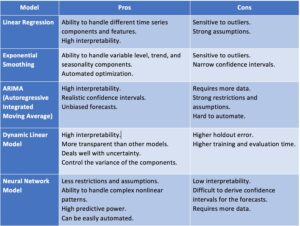
The time series forecasting model is a widely used approach that focuses on analyzing sequential sales data over time. This method aims to identify trends, cyclical patterns, and seasonal fluctuations within the data, allowing businesses to make data-driven predictions about future performance. By recognizing recurring cycles, such as monthly, quarterly, or yearly trends, organizations can anticipate peak periods or downturns in demand, enabling more effective resource allocation, inventory management, and staffing. This approach is particularly beneficial for industries with stable and predictable demand patterns, such as retail, tourism, and agriculture, where historical trends provide a reliable basis for future projections.
Source: Learntek
2) Regression forecasting model
Regression forecasting is a statistical approach that examines the relationship between sales and various external variables, such as marketing campaigns, pricing strategies, consumer behavior, or economic indicators. By assessing how these factors influence revenue, businesses can gain deeper insights into what drives sales and how different elements contribute to overall performance. For example, a company may use regression analysis to determine how an increase in advertising spending correlates with higher sales or to identify the effect of external economic factors, such as inflation or unemployment, on customer purchasing behavior. This great piece by Jason Wong dives deeper into regression forecasting.
3) Historical forecasting model
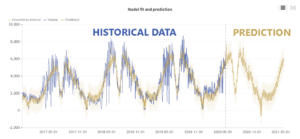
The historical forecasting model is one of the most straightforward approaches to predicting future sales performance. This model relies on past sales data to estimate future outcomes, assuming that sales trends observed in the past will continue in the future. By analyzing historical sales figures, businesses can establish a baseline for their forecasting and use it to project future sales with a reasonable degree of accuracy. This method is particularly effective for businesses with consistent sales patterns and predictable demand, as historical data tends to be a reliable indicator of future performance.
Source: Graphite Note
4) Opportunity stage sales forecasting model
The opportunity stage sales forecasting model focuses on evaluating sales opportunities at various stages of the sales funnel. By assigning probabilities to each stage—such as prospecting, qualification, proposal, and closing—businesses can estimate the likelihood of converting each opportunity into a sale and forecast future revenue accordingly. This guide by Meetrecord dives deeper into how to get the most out of the opportunity stage sales forecast model. This method is particularly valuable for organizations with complex sales processes, such as those in B2B sectors, where deals may take months to close and involve multiple touchpoints with potential customers.
5) Lead value sales forecasting model
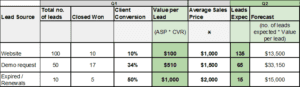
The lead value sales forecasting model focuses on the quality and potential of leads to predict future revenue. Rather than treating all leads as equal, this model assigns values to leads based on factors such as industry, company size, engagement level, or historical conversion rates. By evaluating the potential of each lead, businesses can prioritize high-value opportunities and generate more accurate sales forecasts. This method is particularly common in B2B sales, where lead quality often plays a more significant role in revenue generation than sheer volume.
Source: Revenue.fyi
6) Length of sales cycle forecasting model
The length of sales cycle forecasting model evaluates the average time it takes for a business to close a deal and uses this information to forecast future revenue. By analyzing the duration of the sales cycle for various opportunities, businesses can predict when they are likely to convert those opportunities into revenue and adjust their sales strategies accordingly. This method is particularly useful for industries with clear and well-defined sales processes, where the steps from lead generation to closing are consistent and predictable. Akucast do a great job explaining how to implement this model.
7) Intuitive sales forecasting model
The intuitive sales forecasting model relies on the experience, insights, and judgment of sales teams to predict future revenue. Unlike data-driven methods, which rely on historical data and statistical models, intuitive forecasting taps into the knowledge and expertise of the sales team, allowing them to account for factors that may not be reflected in the data. This can include sudden shifts in market conditions, changes in customer behavior, or new competitor activities that may affect sales performance. Verteego covers more ways to implement this model, to ensure it has a meaningful impact on sales figures.
8) Multivariable analysis sales forecasting model
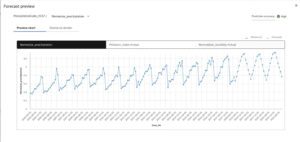
The multivariable analysis sales forecasting model is a comprehensive approach that combines multiple factors to create a more holistic and accurate sales forecast. Unlike simpler models that focus on a single variable, such as historical sales data or lead value, the multivariable analysis considers a range of influencing factors, including market conditions, sales team performance, customer behavior, and external economic indicators. By analyzing these factors together, businesses can improve the accuracy of their forecasts and gain a more complete view of potential sales outcomes. This guide by IBM shows how to generate a multivariable model.
Source: IBM
How to choose the right sales forecasting method?
Selecting the most suitable sales forecasting method involves understanding your business’s unique needs, data availability, and strategic goals. Here’s a step-by-step guide to help you make the best choice:
Define your plan
Start by identifying the objectives of your sales forecast. Are you planning inventory, setting revenue targets, or evaluating market expansion opportunities? Clear goals will guide your choice of methods and ensure the forecast aligns with your priorities.
Gather materials
Collect all necessary data, including historical sales records, customer information, and market trends. The quality and availability of data often determine whether you should use qualitative or quantitative methods for your forecast.
Conduct preliminary analysis
Before choosing a forecasting method, review your data to identify patterns, gaps, or inconsistencies. Preliminary analysis helps refine your understanding of what forecasting approach will be most effective for your specific situation.
Choose your sales forecasting model
Evaluate the forecasting models based on your business’s needs. For instance, use time series analysis for seasonal trends, regression analysis for external influences, or judgmental analysis for uncertain markets.
Select your sales forecasting method
Once you’ve chosen a model, select the specific method that fits your data and goals. For example, combine historical forecasting with expert input for a more nuanced prediction, or rely on quantitative methods for data-rich scenarios.
Assess the results
After generating your sales forecast, evaluate its accuracy and effectiveness. Regularly revisiting your forecasts ensures they remain relevant as market conditions evolve, helping you refine your methods for even greater precision.
How do I ensure the most accurate sales forecasting results?
Accurate sales forecasting is essential for making informed business decisions, managing resources effectively, and achieving revenue targets. While no forecasting method guarantees absolute precision, following best practices can significantly improve accuracy. Here are some key considerations and strategies:
What is sales forecasting software?
Sales forecasting software is a digital tool designed to enhance the forecasting process. By automating data collection, analysis, and reporting, these platforms help businesses predict future sales with greater accuracy and efficiency. The software leverages advanced algorithms, artificial intelligence, and machine learning to analyze historical data, market trends, and other variables.
Modern sales forecasting tools often integrate with other business systems, allowing businesses to combine sales data with customer insights for more precise predictions. These tools also offer features like customizable dashboards, scenario planning, and real-time updates, making it easier for teams to adapt forecasts to changing conditions. Using sales forecasting software reduces the likelihood of human error, saves time, and provides a data-driven foundation for strategic decision-making.
What is the best sales forecasting software?
Choosing the right sales forecasting software is essential for businesses to achieve accuracy, improve efficiency, and align sales goals with overall strategy. Each platform brings unique strengths to the table, but Maximizer leads the pack with its comprehensive features and tailored approach to forecasting. Below is a detailed look at Maximizer and its competitors to help you identify the best fit for your business needs:
Maximizer
Maximizer is a top-tier solution for businesses seeking reliable and efficient sales forecasting. Its advanced tools allow you to analyze historical data, identify trends, and create accurate sales projections. Maximizer’s intuitive design ensures that teams of all sizes can easily adopt its tools, while its customizable dashboards and reporting features provide actionable insights. If you’re tracking individual sales team performance or analyzing broader market trends, Maximizer delivers the clarity and precision needed for confident decision-making. Its scalable nature also ensures it grows with your business, making it a reliable long-term partner for achieving sales goals.
HubSpot
HubSpot’s CRM offers a strong suite of tools for sales forecasting, focusing on ease of use and automation. Teams can view their pipeline in real-time, track progress toward revenue goals, and access automated reports that highlight performance gaps. HubSpot’s strength lies in its ability to integrate sales forecasting with its broader marketing and customer service tools, creating a holistic approach to business growth. For small to medium-sized businesses or those new to forecasting, HubSpot’s intuitive interface and free CRM tier provide an accessible entry point. However, as businesses scale, they may find advanced features limited without upgrading to premium tiers.
Pipedrive
Pipedrive is a visual and user-friendly platform designed for sales teams prioritizing simplicity. Its sales forecasting tools are built directly into its pipeline management system, offering easy access to predictive analytics and performance metrics. Businesses can use Pipedrive to set revenue goals, monitor progress, and identify areas for improvement in their sales process. Pipedrive excels in helping small to mid-sized businesses with straightforward forecasting needs. Its drag-and-drop interface and customizable fields make it easy for teams to adapt the platform to their unique requirements. However, it may lack the advanced analytics and scalability larger organizations require.
Monday.com
Monday.com is a versatile platform known for its project management features but has gained traction in sales forecasting. Its customizable workflows and integrations allow businesses to merge CRM data with forecasting tools. With advanced analytics and automation, Monday.com provides a flexible solution for businesses that require tailored processes. The platform’s visual dashboards and collaborative features make it an excellent choice for teams that value transparency and shared accountability in their forecasting efforts. However, its sales forecasting capabilities are still evolving, making it better suited for companies already invested in the Monday.com ecosystem.
Salesforce
Salesforce is renowned as a leader in CRM and sales forecasting. Its AI-powered Einstein Analytics offers unparalleled insights, combining historical data with predictive modelling to help businesses create highly accurate forecasts. Salesforce supports real-time updates, scenario planning, and in-depth pipeline analysis, making it ideal for enterprises that require complex and scalable solutions. While Salesforce’s capabilities are impressive, its advanced features come with a steep learning curve and higher costs, making it more suitable for larger organizations with dedicated teams to manage the platform.
Zoho
Zoho CRM is an affordable yet robust solution for businesses seeking an all-in-one platform. Its sales forecasting tools include pipeline management, scenario analysis, and trend tracking, helping teams create forecasts aligned with their goals. Zoho’s competitive pricing and flexibility make it an excellent choice for small businesses and startups. The platform also integrates with other Zoho tools, creating a unified system for managing sales, marketing, and operations. However, its functionality may not meet the needs of larger businesses or those requiring advanced customization.
Subscribe to our Newsletter
Related Articles