Top 5 AI-Powered CRMs and AI CRM Use Cases in 2025

Choosing the right CRM in 2025 isn’t just about managing contacts, it’s about how well your team can anticipate, respond to, and build real relationships with customers. The latest AI-powered CRMs are no longer passive databases; they actively help teams close deals, spot patterns, suggest improvements, and make better decisions without the guesswork. Today’s AI-powered CRMs optimize your digital experience without any prompting or input – they instinctively incentivize your customer relationships, so each client feels seen, heard and appreciated. In this post, we’ll look at the top five AI CRMs leading the way this year and explore how real businesses are using them to work smarter, not harder, from forecasting sales to crafting personalized experiences that resonate and much more.
What is AI CRM?
AI CRM refers to customer relationship management software enhanced with artificial intelligence technologies. It uses machine learning, natural language processing, and data analytics to identify patterns, predict behaviour, and improve how companies interact with customers. Unlike traditional CRMs that passively store data, AI CRMs actively provide insights, recommend actions, and automate interactions. This helps teams prioritize leads, personalize outreach, and adapt strategies based on real-time information. AI-powered CRM transforms a static database into a dynamic decision-making system that grows smarter with each use.
How does AI-powered CRM benefit business in 2025?
In 2025, businesses gain a measurable edge by using AI-powered CRMs to improve revenue, retention, and responsiveness. These platforms uncover actionable insights from customer data, helping teams anticipate needs and respond with relevance. Predictive analytics guide sales strategies, while AI-generated recommendations improve customer engagement. By reducing time spent on repetitive tasks and enabling data-informed decisions, AI CRMs improve productivity across sales, marketing, and support. The result is more efficient operations, higher conversion rates, and better overall customer experiences.
Increase productivity and efficiency
AI-powered CRMs boost team output by reducing manual effort. Tasks like email logging, meeting summaries, follow-up reminders, and data updates happen automatically in the background. Sales and support reps spend less time on data entry and more time focusing on high-impact conversations. AI assistants also suggest the next best actions or highlight stalled deals, helping users prioritize more effectively. This shift toward intelligent automation allows smaller teams to accomplish more without sacrificing accuracy or responsiveness.
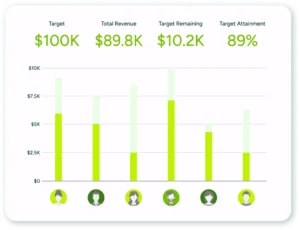
Using predictive analytics for sales forecasting
AI enables CRMs to tailor customer experiences based on individual behaviour, preferences, and engagement history. By analyzing past interactions, browsing patterns, and sentiment, the system can suggest personalized messages, offers, or product recommendations. Sales and support teams gain deeper context before reaching out, while marketing can trigger campaigns that feel timely and relevant. This level of personalization fosters stronger relationships, improves customer satisfaction, and increases conversion rates across the buyer journey.
Personalizing customer interactions
AI enables CRMs to tailor customer experiences based on individual behaviour, preferences, and engagement history. By analyzing past interactions, browsing patterns, and sentiment, the system can suggest personalized messages, offers, or product recommendations. Sales and support teams gain deeper context before reaching out, while marketing can trigger campaigns that feel timely and relevant. This level of personalization fosters stronger relationships, improves customer satisfaction, and increases conversion rates across the buyer journey.
Enhance decision making
AI-powered CRMs help leaders and frontline teams make better decisions by turning complex data into clear, actionable insights. Dashboards update in real-time, highlighting key trends, performance gaps, or emerging opportunities. With automated lead scoring, segmentation, and behavioural analysis, businesses can allocate resources more strategically. Managers no longer rely solely on intuition—they get concrete guidance on where to focus and why. This clarity improves outcomes across sales, customer success, and marketing operations.
Automating routine tasks
AI CRMs handle repetitive tasks that previously consumed hours of human effort. These include auto-sending follow-ups, drafting emails, scheduling meetings, tagging contacts, and updating records. Some systems even generate summaries of calls or analyze support tickets to suggest responses. This automation keeps customer data current and communications timely, reducing delays and human error. As a result, employees can devote more attention to high-value activities like closing deals or resolving complex customer issues.
AI CRM use cases
Financial and Professional Services
In financial services and consulting, AI CRMs track client preferences, detect risk signals, and surface relevant insights before meetings. They help advisors prioritize outreach based on changes in market conditions or client activity. For compliance-heavy industries, these systems flag anomalies or gaps in documentation. Professionals save time by receiving summaries of past interactions, while predictive tools help with upselling or cross-selling services based on client profiles and financial goals.
E-commerce and Retail
AI CRMs in retail personalize shopping experiences by analyzing clicks, purchases, and abandoned carts. They predict what customers may want next and send tailored messages that improve engagement. For customer retention, the system alerts staff when interest is fading and suggests promotions to re-engage. Managers gain clarity on buying trends and inventory issues, while marketers get help with campaign timing and content selection based on real-time shopper behaviour.
Sales
Sales teams use AI CRMs to focus on the right leads at the right moment. Instead of sorting through long lists manually, they get ranked suggestions of who’s most likely to respond. The system captures meeting notes, tracks follow-ups, and even nudges reps when deals are at risk of stalling. Over time, it learns from successful deals and helps replicate that success by offering practical guidance based on past outcomes.
Customer Service
In customer support, AI CRMs recommend replies based on past conversations and customer sentiment. They group similar issues so teams can address them faster and identify topics that cause repeat tickets. When a high-value customer reaches out, the system highlights their history so agents respond with context. AI also flags frustrated users early, helping teams recover relationships before complaints escalate or go public on review sites.
Operations and Productivity
AI CRMs reduce manual updates and keep information current by automatically logging emails, meetings, and calls. They highlight internal bottlenecks, such as delayed approvals or slow follow-ups, helping managers fix workflow issues. For busy teams, the system acts as a reminder assistant—alerting them to deadlines or client needs. Over time, it reveals which processes consume the most effort, giving leaders data to redesign how teams collaborate and prioritize work.
Key AI features to look for in CRMs
Predictive lead scoring and sales forecasting
This feature helps sales teams focus their energy where it counts. AI analyzes past deals, communication patterns, and customer behaviour to score leads based on likelihood to convert. Sales forecasts become more reliable because they’re based on evolving data, not just gut instinct or outdated spreadsheets. This allows teams to set more accurate targets, avoid surprise slumps, and plan their resources around real trends. It also helps managers coach reps with clearer performance insights.
AI-powered chatbots and virtual assistants
These tools help teams respond quickly and consistently. AI chatbots handle common questions instantly, freeing up human agents for more complex issues. Virtual assistants go further—they help staff schedule follow-ups, summarize interactions, and surface useful information mid-call. Unlike basic scripts, modern assistants learn from interactions and adjust over time, improving both speed and quality. Customers benefit from faster service, while teams can stay organized without juggling dozens of open tabs or missed tasks.
Next best action recommendations
AI doesn’t just track data—it suggests what to do with it. This feature highlights which customer to contact, what message to send, or when to follow up, based on live behaviour and past outcomes. It helps staff avoid guesswork by offering guidance that’s tied to real patterns. For example, it might recommend offering a discount to a hesitant buyer or suggest waiting before another outreach. These small nudges add up to smarter, more timely engagement.
Automated workflows and recommendations
Repetitive steps can slow teams down, especially when follow-ups, assignments, or approvals pile up. AI in CRMs can trigger actions based on customer behaviour—like sending a thank-you email after a purchase or alerting a rep when a deal goes cold. It keeps everyone on track without manual oversight. Notifications ensure that nothing falls through the cracks, while custom workflows help different teams stay aligned. The result: faster reactions, fewer mistakes, and better customer experiences.
Top 5 best AI CRM software platforms
Maximizer CRM with IQ Boost
Maximizer’s AI CRM is built for teams who value relationships but want the efficiency of intelligent automation. Acting as a personal assistant, it summarizes daily activities, surfaces key insights, and delivers recommendations to help sales teams focus on what matters. The platform combines AI-driven data capture with decision support tools to reduce manual effort and improve sales effectiveness—all while preserving the human element that builds customer loyalty.
Features
- No hidden costs
- AI-generated daily summaries and sales recommendations
- Automated data capture to improve CRM accuracy
- Actionable insights for sales strategy optimization
- Task automation to reduce time spent on routine activities
- Cloud-based collaboration for shared access to updated data
- Focus on blending AI support with human relationship-building
- Integrated with other major platforms like Outlook, Slack and more
- Highly customizable
- Tailored to financial professionals
Pros
- Designed specifically for sales-focused organizations
- Emphasizes maintaining human touch while improving efficiency
- Helps teams reduce time spent on data entry and admin
- Enhances decision-making with consistent, accurate insights
- Simplifies daily workflows without overwhelming users with features
Cons
- Smaller ecosystem compared to larger CRM platforms
- Advanced customizations or integrations may be limited for complex needs
Salesforce CRM (Salesforce Einstein)
Salesforce Einstein is the AI layer within Salesforce CRM, offering predictive insights and generative content directly within business workflows. Natively embedded into the Salesforce Platform, it uses CRM and external data to provide real-time support, personalized content, and intelligent automation. With a conversational interface and customizable AI builders, Einstein brings contextual intelligence into every part of the user journey, from sales to service.
Features
- AI-powered predictions and content generation
- Conversational UI for seamless interaction
- Customizable prompts, models, and skills
- Generative tools for emails, replies, and more
- Agentforce: configurable AI agents for 24/7 support
- Built on the Einstein Trust Layer for secure, compliant use
Pros
- Deep native integration with Salesforce tools
- Uses first-party CRM and Data Cloud data for relevance
- Enhances productivity by automating routine tasks
- Maintains strong data security and compliance standards
- Reduces dependence on third-party AI vendors
Cons
- Best suited for organizations already using Salesforce
- Customization and full capability access may require technical expertise
- Potential cost considerations for advanced AI features
HubSpot CRM with HubSpot AI
Breeze AI is HubSpot’s integrated AI suite, designed to enhance marketing, sales, and service functions across the customer journey. Built into the HubSpot ecosystem, Breeze provides AI-driven support for content creation, lead management, customer interaction, and predictive analytics. With tools like Breeze Assistant and Breeze Agents, users gain contextual AI support that adapts to their specific workflows, using CRM data to deliver meaningful, personalized results.
Features
- Breeze Assistant: AI companion with full CRM and business context access
- Breeze Agents: AI teammates for marketing, sales, and engagement tasks
- Predictive lead scoring, sales forecasting, and actionable CRM insights
- AI-powered notetaking, content drafting, and inquiry responses
- Marketing automation for emails, social media, website creation, and distribution
- Embedded across HubSpot’s platform with transparency and trust built in
- Free access to core tools, with advanced features in premium plans
- Public beta access available with opt-in
Pros
- Natively integrated with HubSpot’s full platform
- Personalized AI support based on CRM data and business behaviour
- Wide range of use cases: sales, marketing, content, and service
- User-friendly customization through Breeze Studio and Marketplace
- Transparent AI practices with public model cards and safety standards
- Free tier allows easy entry into the AI tools ecosystem
Cons
- Advanced features (Breeze Agents) require premium HubSpot plans
- Currently in public beta—features may evolve or be limited
- Full value is best realized by teams already using HubSpot extensively
Pipedrive with AI Sales Assistant
Pipedrive AI enhances sales performance by automating manual tasks, improving communication, and offering intelligent insights. Embedded within the Pipedrive CRM platform, AI features like smart notifications, email tools, and automated reporting help sales teams focus on closing deals faster. With built-in AI for summarizing emails, recommending next actions, and generating reports, Pipedrive supports smarter decision-making at every stage of the sales cycle.
Features
- AI-generated email creation and summarization
- Smart deal prioritization and next-step recommendations
- AI-generated sales reports via natural language input
- AI app and integration recommendations
- Marketplace search using natural language (powered by OpenAI)
- Mobile access, team task assignment, and user management tools
- Security features with customizable permission settings
- 24/7 support via phone, email, and chat
- Available across all plans, with 14-day free trial
Pros
- Easy-to-use AI tools that save time and boost productivity
- Strong support for sales workflows with actionable insights
- Natural language reporting and marketplace search simplify tasks
- Built-in communication tools improve response times and conversion rates
- Seamless integration with third-party apps
- Accessible on mobile devices, supporting remote work
Cons
- Primarily sales-focused—limited capabilities beyond core sales functions
- Advanced AI features are still evolving (some in beta)
- May lack deep customization options compared to enterprise-grade CRMs
Zoho CRM with Zia AI
Zoho’s AI-powered CRM, Zia, brings advanced intelligence into every aspect of customer management—from sales automation to strategic decision-making. Zia supports teams with predictive insights, generative content, intelligent recommendations, and data enrichment. With voice, vision, and email AI capabilities, Zia helps businesses understand and engage customers more effectively. For companies with unique needs, custom AI models can be built using Zoho’s QuickML, expanding beyond standard AI tools.
Features
- AI Agents: Perform business tasks autonomously
- Generative AI: Build reports, modules, and workflows with simple prompts
- Sales Prediction: Churn prediction, field prediction, and revenue forecasting
- Product Recommendations: Suggest upsell/cross-sell opportunities and next best offers
- Data Enrichment: Fill in gaps using email signatures and online sources
- Anomaly Detection: Spot unusual trends or deviations
- Automation: Suggest workflows and process optimizations
- Email & Call AI: Transcribe calls, assess sentiment, and suggest responses
- Vision AI & ICR: Extract data from images and detect duplicates
- Voice of the Customer: Monitor brand perception and customer sentiment
- Custom AI (QuickML): Build and train machine learning models for specific use cases
Pros
- Deep AI integration across sales, marketing, and support
- Strong predictive and prescriptive analytics
- Vision and voice capabilities add multi-modal intelligence
- Highly customizable AI through QuickML
Cons
- May require training for teams to use full feature set
- Advanced AI features may need higher-tier plans or technical configuration
- Custom model building with QuickML may not suit non-technical users
Comparison table of the best AI CRM in 2025
| Category | Maximizer CRM (IQ Boost) | Salesforce CRM (Einstein) | HubSpot CRM (Breeze AI) | Pipedrive (AI Assistant) | Zoho CRM (Zia AI) |
| Focus | Finance, wealth & human touch | Full-scale AI for CRM ops | Sales, marketing & service | Sales task automation | AI across all CRM functions |
| Key AI Tools | • Daily summaries
• Smart insights • Auto data capture |
• Predictive AI
• Gen content • Conversational UI |
• Breeze Agents
• AI scoring • Content creation |
• Email AI
• Deal suggestions • AI reporting |
• AI Agents
• Custom ML • Vision/voice AI |
| Strengths | Simple, Relationship-first | Deep native AI Secure & scalable | All-in-one AI User-friendly tools | Fast setup Great for SMBs | Predictive & multimodal Custom AI options |
| Pros | ✔️ Easy & efficient
✔️ Low admin time |
✔️ Deep integration
✔️ Enterprise-grade AI |
✔️ Versatile
✔️ Free tier available |
✔️ Time-saving
✔️ Mobile friendly |
✔️ Customizable
✔️ Advanced insights |
| Cons | ❌ Narrow scope
❌ Limited ecosystem |
❌ Complex setup
❌ Higher cost |
❌ Beta features
❌ Best w/ HubSpot use |
❌ Sales-only
❌ Limited depth |
❌ Steeper learning
❌ Tech skills needed |
| Best For | Finance professionals wanting deep, actionable insights | Large orgs using Salesforce | Growth teams needing AI across funnel | Sales-driven SMBs | Data-savvy teams needing full AI power |
FAQs: Best AI-powered CRM
Can we combine CRM and AI?
Yes, AI can enhance CRM systems by automating tasks, predicting customer behaviour, and offering real-time insights to support smarter decisions.
What is the future of AI in CRM?
AI will increasingly personalize customer interactions, automate workflows, and guide teams with predictive insights across sales, marketing, and service.
What is the #1 CRM in the Canada?
Each CRM provides a unique experience to the user and Maximizer CRM stands out from the competition due to its customization, usability, and overall functionality for finance professionals in Canada.
Is Maximizer AI good for CRM?
Yes, Maximizer AI focuses on improving sales performance while preserving the human touch, making it a solid choice for relationship-driven teams.
Does Zoho CRM have AI?
Yes, Zoho CRM includes Zia, its AI engine, which offers predictions, recommendations, data enrichment, and intelligent automation.
Does Salesforce CRM use AI?
Yes, Salesforce uses Einstein AI to deliver predictive insights, content generation, and workflow support across its platform.
What is CRM in AI?
CRM in AI refers to using artificial intelligence within customer relationship management systems to analyze data, automate tasks, and improve customer interactions.
What are the three commonly used examples of AI in CRM?
Common examples include lead scoring and sales predictions, AI-generated emails and content, and customer service chatbots or virtual assistants.
Subscribe to our Newsletter
Related Articles