CRM Reporting: What Is a CRM Report and How It Drives Insights

Summary of CRM reporting
CRM reporting transforms raw customer and sales data into actionable insights that guide business strategy and performance. With customizable dashboards, automated reporting, and AI-powered analytics, CRM tools like Maximizer help teams track sales, measure engagement, and identify opportunities in real time. From small businesses to large enterprises, effective CRM reporting ensures better decision-making, improved accountability, and stronger alignment across departments.
-
Data-driven business decisions: CRM reporting empowers teams to replace guesswork with real-time metrics, uncover hidden trends, and support strategic planning across sales, marketing, and leadership.
-
Enhanced performance and accountability: Reports provide visibility into team activities, highlight top performers, and help managers set measurable goals to drive continuous improvement.
-
Automation and integration: With scheduled reports and integrations with tools like Microsoft 365, businesses can save time and unify data for more efficient, cross-functional insights.
-
Maximizer CRM advantage: Maximizer combines AI-powered analytics, real-time dashboards, and all-in-one sales and client tracking, making it the top CRM reporting solution for growth-focused businesses.
Understanding CRM Reporting
What is a CRM report?
A CRM report is a data-driven summary that captures key information stored in your customer relationship management system. It transforms raw data, such as sales activity, client interactions, and deal stages, into meaningful insights that help businesses understand what’s working, what isn’t, and where opportunities lie.
These reports can range from simple tables of contact activity to detailed dashboards visualizing pipeline progress or client engagement. They provide both high-level overviews and granular detail, allowing teams to align their strategies with real-world outcomes. When powered by a robust CRM like Maximizer, reporting becomes more than just tracking, it becomes the foundation for smarter business decisions.
Why CRM reporting matters for businesses
These days, data alone isn’t enough, it’s the interpretation that drives performance. CRM reporting empowers businesses to turn customer and sales data into actionable intelligence. Whether you’re monitoring team productivity, measuring campaign effectiveness, or tracking quarterly revenue goals, reports allow you to react in real time and adjust strategies accordingly. Instead of relying on guesswork, companies can use reporting tools to pinpoint strengths, diagnose problems, and uncover trends that might otherwise go unnoticed. From leadership to front-line staff, everyone benefits from having visibility into performance metrics that matter most.
The role of CRM reports in 2025 business strategy
As businesses adopt more digital tools, the importance of CRM reporting continues to grow. In 2025, real-time analytics and cross-functional dashboards are becoming standard for organizations that want to stay agile and proactive. CRM reports now influence strategic planning at every level, from lead generation to post-sale service. Reports are also playing a larger role in automation, triggering follow-up workflows, client communications, or internal alerts based on data changes. Combined with AI-driven insights, CRM reporting is evolving into a key driver of predictive decision-making, not just a record of past activity.
Key features of CRM reporting
Customizable dashboards and visualizations
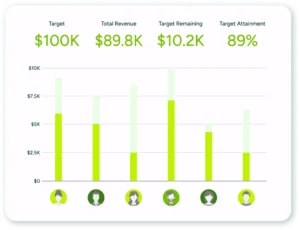
One of the most valuable features of modern CRM reporting is the ability to customize dashboards to fit your business needs. Users can create tailored views that highlight the most relevant data, such as current sales performance, top client accounts, or active opportunities by stage. These dashboards make it easy to interpret complex data through charts, graphs, and tables that update in real time.
Customization ensures that each team member sees exactly what they need, whether it’s a sales rep tracking daily activity, a support team monitoring service metrics, or an executive reviewing quarterly trends. This flexibility allows businesses to keep everyone aligned, empowered, and informed, without overwhelming users with unnecessary or unrelated information.
Sales and pipeline performance tracking
CRM reports offer detailed insights into the entire sales funnel, from initial contact to closed deal. Managers can assess which reps are performing best, where deals tend to stall, and how close the team is to reaching revenue goals. This data is crucial for forecasting, budgeting, and adjusting sales strategies mid-cycle.
By analyzing conversion rates, deal sizes, pipeline velocity, and historical sales patterns, businesses gain a much clearer picture of what drives success. These reports also help identify underperforming areas, guide coaching opportunities, and provide accountability by highlighting progress toward individual and team-wide targets.
Client interaction and engagement analytics
Beyond tracking sales, CRM reporting tools also measure how your team engages with clients. Reports can include data on follow-up frequency, response times, email open rates, and meeting history, all of which help assess relationship quality. Understanding client engagement patterns allows teams to refine their communication strategies, identify accounts that need more attention, and nurture relationships that have long-term value. These insights also support better segmentation, enabling businesses to personalize outreach and allocate resources to the clients that matter most.
Automated report generation
To support better decision-making, CRM systems now offer automated reporting features that save time and ensure consistency. Reports can be scheduled to generate and distribute at regular intervals, daily, weekly, or monthly without the need for manual setup. This automation ensures that leadership, sales teams, and support staff always have up-to-date information in their inboxes, enabling faster responses and fewer delays. It also reduces human error, maintains reporting accuracy, and removes the administrative burden of building reports from scratch, allowing staff to focus on insights, not spreadsheets.
Integration with business intelligence tools
Advanced CRM platforms like Maximizer offer integration with leading business intelligence tools such as Microsoft 365. These integrations allow companies to blend CRM data with broader datasets, like marketing, finance, or support metrics, for a more complete picture of business performance. This level of connectivity transforms CRM reporting into a strategic asset for cross-department decision-making. It helps unify fragmented data across systems, reveals patterns that might otherwise be hidden, and supports higher-level analytics efforts that drive sustained growth and customer success.
Benefits of using CRM reporting
Data-driven decision making
-
Replace guesswork with insight: CRM reporting empowers businesses to eliminate uncertainty from their decision-making process by providing clear, quantifiable data. From forecasting revenue to adjusting marketing strategies, every action can be aligned with real performance metrics, leading to smarter, more confident business moves.
-
Surface hidden opportunities and risks: With built-in analytics, CRM tools reveal trends that aren’t immediately visible, such as underperforming segments or high-value clients with untapped potential. These insights allow businesses to proactively seize new opportunities or mitigate risks before they impact the bottom line.
-
Support strategic planning across departments: By giving all departments access to the same real-time data, CRM reporting facilitates better collaboration and long-term alignment. Marketing, sales, service, and leadership can each draw on a shared foundation of insight to coordinate priorities and maximize ROI.
Improved sales and client retention
-
Track the entire customer journey: CRM reports visualize every stage of the buyer lifecycle, from the first point of contact to post-sale engagement, allowing teams to fine-tune their messaging and timing based on what actually drives conversions. This level of visibility supports more personalized and effective sales efforts.
-
Identify top-performing reps and campaigns: Reporting tools highlight which salespeople, lead sources, and marketing initiatives are generating the strongest outcomes, helping teams double down on what works. These performance insights support smarter budget allocation, training, and strategic refinement across the board.
-
Spot at-risk clients early: Engagement metrics and behaviour trends make it possible to identify clients who are disengaging or showing signs of dissatisfaction. This early warning system gives account managers a chance to step in, re-engage, and preserve valuable relationships before they’re lost.
Enhanced team performance and accountability
-
Create visibility into team activity: CRM reports offer leadership a detailed snapshot of how individuals and teams are performing over time, including outreach frequency, follow-up success, and deal progression. This transparency helps uncover gaps and recognize standout contributors.
-
Set measurable goals and expectations: With accurate and consistent data, managers can establish clear performance targets tailored to each role. These benchmarks help guide daily activity and create a results-oriented culture grounded in fairness and achievement.
-
Foster a culture of continuous improvement: Reporting isn’t just about oversight; it’s about learning. By tracking key metrics over time, teams can evaluate what’s driving success, adjust strategies accordingly, and maintain a steady path toward operational excellence.
Time savings with automated insights
-
Reduce time spent on manual reporting: Instead of exporting data into spreadsheets and building reports from scratch, teams can rely on automated dashboards that deliver real-time results. This efficiency allows businesses to reallocate hours toward higher-value work.
-
Deliver key metrics without delay: Scheduled reports ensure that leadership always has access to the latest information without having to chase down updates. From weekly sales summaries to monthly pipeline health checks, the right data arrives exactly when it’s needed.
-
Focus efforts on analysis and strategy: When reporting becomes automatic, teams can shift their energy toward identifying insights, planning campaigns, and refining processes. This focus on strategy, rather than manual labour, drives long-term growth and efficiency.
CRM reporting across different industries
CRM reports for real estate and financial services
In industries where relationships and trust are at the core of every transaction, CRM reporting becomes a critical asset. For real estate professionals, reports help agents and brokers monitor deal progression, client communication, and property interest, ensuring no lead is neglected and follow-ups happen on time. Reports can also be used to compare listing performance, track showing schedules, and analyze referral patterns.
In financial services, CRM reporting supports compliance, retention, and portfolio management. Advisors and institutions can track client interactions, product engagement, and risk levels, helping them deliver personalized service while maintaining a clear audit trail. These reports not only improve client experience but also ensure advisors stay aligned with evolving financial regulations.
Features for sales and marketing teams
Sales and marketing departments rely on CRM reports to fine-tune outreach strategies, measure ROI, and forecast growth. For sales teams, reports highlight top-performing reps, monitor pipeline movement, and assess quota progress. Managers can quickly identify which deals need attention, which stages are bottlenecked, and where coaching is required.
Marketing teams use CRM data analytics to evaluate campaign performance across email, social media, and lead-gen efforts. By linking marketing efforts to actual sales outcomes, teams can understand what drives conversions and refine targeting, messaging, and budgets with greater accuracy.
Managing small businesses vs. large enterprises
Small businesses often turn to CRM reporting to maximize efficiency with limited resources. These companies benefit from simplified dashboards that focus on core metrics, like lead response time, customer satisfaction, and close rates, without needing a dedicated analytics team. The insights allow small teams to work smarter and scale strategically.
Large enterprises, on the other hand, use CRM reporting tools to unify data across departments and regions. With layered user roles, complex KPIs, and high-volume pipelines, reports help executives maintain visibility and enforce accountability at scale. Integration with business intelligence platforms ensures that enterprise-level strategies are always grounded in current, accurate data.
How to choose the right CRM reporting tools
Step 1: Identify your key performance metrics
The first step in selecting the right CRM reporting tool is to define what success looks like for your business. Are you focused on increasing conversion rates, improving client retention, or speeding up the sales cycle? Knowing which metrics matter most helps you determine what kind of reporting features you’ll actually use.
Once your goals are clear, you can ensure your CRM supports the tracking of those specific KPIs, whether that’s win/loss rates, time spent in each deal stage, or customer satisfaction scores. Starting with clear priorities will help you avoid being overwhelmed by irrelevant data.
Step 2: Ensure integration with existing tools
Your CRM reporting system should integrate easily with the platforms you already use. Whether it’s your email provider, marketing automation software, or financial reporting tools, connected systems allow for smoother workflows and more comprehensive insights. Integrating your CRM with external tools not only reduces manual entry but also helps ensure your data stays up to date. It’s especially useful for creating end-to-end visibility across departments, making it easier to measure performance and outcomes in a unified, accurate way.
Step 3: Prioritize customization and automation
Every business is different, and your reporting system should reflect that. Look for CRM tools that allow you to customize dashboards, filters, and fields to match your specific processes and terminology. This flexibility helps you focus on what matters most to your team, without trying to fit your workflow into a rigid reporting structure. In addition to customization, automation is key. Tools that support scheduled reports, real-time updates, and triggered alerts help ensure that your team always has access to the most current information without needing to build each report manually.
Step 4: Evaluate user-friendliness and scalability
No matter how powerful a CRM tool is, it needs to be easy for your team to use. Look for a platform with an intuitive interface, clear navigation, and helpful tutorials or onboarding resources. The less time your team spends learning the software, the faster they can start putting reports to use. It’s also important to consider scalability. As your team or data grows, your CRM reporting solution should be able to keep up, offering advanced features, deeper integrations, and the capacity to support more users without compromising performance.
Why Maximizer CRM is the top solution for CRM reporting
AI-driven analytics for actionable insights
Maximizer CRM goes beyond basic reporting by offering AI-powered analytics that uncover patterns, predict outcomes, and support smarter decision-making. These tools help businesses understand what’s driving performance from individual sales trends to broader customer engagement behaviour, and translate data into clear, practical recommendations. With Maximizer’s analytics tools, users can dive deeper into their data without needing a dedicated analyst. The system delivers real-time insights across departments, making it easier for teams to stay aligned, adapt quickly, and stay focused on results.
Reporting across sales and clients in one platform
One of the biggest advantages of Maximizer CRM is its ability to consolidate reporting for both client relationships and sales activity in one place. From pipeline tracking to customer satisfaction metrics, users can monitor all stages of the customer lifecycle from a single, centralized dashboard. This unified approach helps businesses connect their sales strategy with their service delivery, improving visibility and enabling teams to work more collaboratively. It also allows managers to pinpoint opportunities and challenges across the client journey, not just at the point of sale.
Integration with tools like Microsoft 365 and Tableau
Maximizer integrates easily with powerful business tools like Microsoft 365, allowing teams to extend their CRM data into broader reporting environments. These integrations support advanced visualizations, interactive dashboards, and multi-source analytics that enhance business intelligence capabilities. By linking CRM reporting with the platforms teams already use, Maximizer makes it easier to analyze performance trends, share results with stakeholders, and embed insights into everyday workflows. This adaptability supports businesses of all sizes, from growing teams to enterprise organizations.
Subscribe to our Newsletter
Related Articles