Sales Pipeline Management: A Comprehensive Guide

What is a sales pipeline
A sales pipeline is a structured representation of a potential customer’s stages, from initial awareness to becoming a paying client. It acts as a visual framework that allows sales teams to track, analyze, and manage opportunities effectively. Sales pipeline management is a critical element of any successful sales strategy, ensuring that leads are consistently nurtured and moved toward conversion. Businesses that actively manage their sales pipelines often report better forecasting accuracy and improved close rates, leading to sustained revenue growth.
Definition of sales pipeline management
Sales pipeline management refers to the process of organizing, monitoring, and optimizing the flow of potential customers through the various stages of a sales pipeline. It provides sales teams with a clear overview of their opportunities, helping them prioritize high-value prospects and identify bottlenecks. Effective management ensures that no opportunity falls through the cracks while also providing valuable data on team performance and overall pipeline health.
Why is sales pipeline management important
Sales pipeline management is vital because it directly impacts a company’s ability to meet its revenue targets. By maintaining an organized approach to tracking prospects, businesses can improve their win rates and shorten sales cycles. Additionally, it allows for better resource allocation, as sales teams can focus on opportunities with the highest likelihood of closing. For managers, a well-maintained sales pipeline provides actionable insights into performance trends and areas for improvement, ensuring the entire sales process runs smoothly.
What is the difference between a sales pipeline vs a sales funnel?
Although the terms “sales pipeline” and “sales funnel” are often used interchangeably, they represent distinct concepts. A sales pipeline focuses on the actions taken by sales teams to move leads through predefined stages, such as contacting, qualifying, and closing. In contrast, the sales funnel emphasizes the buyer’s journey and their progression from awareness to decision-making. Understanding these differences is crucial for businesses looking to optimize both aspects, as the two work hand in hand to convert leads into customers.
Fundamental stages when building a sales pipeline
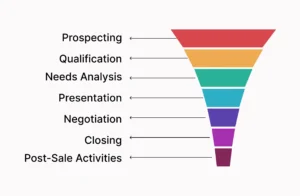
Building a successful sales pipeline requires a clear understanding of the foundational stages. Each step plays a critical role in guiding prospects toward conversion while maintaining an organized approach to opportunity management.
Source: Convin
Prospecting
Prospecting is the first step in any sales pipeline, where you identify potential leads who align with your ideal customer profile. This stage is pivotal as it shapes the rest of the sales process. Effective prospecting relies on thorough research, data analysis, and targeted outreach to ensure that only the most qualified leads enter the pipeline.
Qualifying
After identifying potential leads, the next step is to qualify them. Qualification ensures that your sales team focuses on prospects who have the intent, budget, and authority to purchase. By asking key questions and evaluating data, sales representatives can determine whether a lead is worth pursuing further.
Needs Analysis
In this stage, you dig deeper to understand the specific needs and pain points of your leads. A thorough needs analysis helps identify how your product or service can solve their challenges. By asking insightful questions and actively listening, you can tailor your approach to meet their unique requirements, increasing the likelihood of a successful sale.
Presentation
The presentation stage is where you showcase the value of your product or service. This involves highlighting its features, benefits, and how it addresses the prospect’s specific needs. A well-prepared and customized presentation can turn interest into engagement, making this a crucial phase for driving conversions.
Negotiation
Negotiation is where you work towards finalizing the deal. During this phase, you’ll address any concerns, handle objections, and find mutually beneficial terms. Skilled negotiators aim to create win-win scenarios that satisfy both the prospect and your sales team, ultimately paving the way for closing the deal.
Closing
Closing is the culmination of all previous efforts, where you seal the deal. This stage focuses on finalizing the terms, signing contracts, and ensuring that both parties are committed to the agreement. Strong closing techniques are essential to move prospects from potential to confirmed customers.
Post-Sales Activity
Post-sales activity is crucial for long-term success and customer retention. After closing the deal, maintaining ongoing communication, providing customer support, and seeking feedback ensures a positive experience. Following up and building lasting relationships helps create opportunities for upselling, cross-selling, and repeat business.
How to build a sales pipeline
Creating an effective sales pipeline involves careful planning and regular optimization. By following a structured approach, businesses can ensure their pipeline remains a valuable tool for driving consistent results.
Define the stages of your sales pipeline
Clearly defining each stage of your sales pipeline is the foundation of effective pipeline management. Each stage should represent a specific action or milestone in the sales process, such as initial contact, product demonstration, or contract negotiation. Well-defined stages provide clarity for your sales team and enable more accurate tracking of opportunities.
Identify how many opportunities continue through each stage
Analyzing the flow of opportunities through your pipeline is essential for identifying trends and optimizing performance. By calculating the conversion rates between stages, you can determine where prospects are most likely to drop off and adjust your strategies accordingly.
Calculate the opportunities you need to hit your goals
A thorough understanding of your revenue targets and sales cycle allows you to calculate the number of opportunities needed at each stage to meet your goals. This data-driven approach ensures your team focuses on the right volume of leads to achieve consistent success.
Understand the commonalities between opportunities that convert
Identifying patterns among successful opportunities can provide valuable insights into what drives conversions. Look for shared characteristics, such as lead source, industry, or deal size, and use this information to refine your approach.
Create or adapt your sales process around this data
Data-driven decision-making is a cornerstone of effective sales pipeline management. Use the insights gained from analyzing your pipeline to make targeted adjustments to your sales process. This ensures your strategy remains aligned with your business objectives.
Continuously add leads to your pipeline
A dry sales pipeline can hinder growth and derail your sales efforts. To prevent this, prioritize consistent lead generation through a combination of marketing campaigns, referrals, and networking. By maintaining a steady flow of new leads, you can ensure your pipeline remains robust and productive.
What are the best sales pipeline management tools?
Choosing the right tools for sales pipeline management can significantly impact a business’s ability to track and convert leads effectively. Modern tools offer features like automation, reporting, and integration to optimize the process. Below are some of the best tools for B2B sales pipeline management:
Maximizer
Maximizer is a customizable CRM designed for SMEs and larger businesses that’s popular among Canadian financial advisors in 2024. It integrates sales, marketing, and customer service into one platform, making client lifecycle management more efficient—from prospecting to retention—without the need for multiple tools. Advisors benefit from powerful sales tracking, customized workflows, and compliance with Canadian privacy regulations like PIPEDA. Automation features, such as reminders and follow-up tasks, reduce manual work and enhance client experiences. Maximizer helps advisors boost efficiency, improve client relationships, and stay competitive.
Key features:
- Client & contact management: Advanced tools for storing and tracking client information, communication history, and financial profiles.
- Sales automation: Enables advisors to manage the sales pipeline, track leads, and set up automated workflows.
- Customizable dashboards: Users can tailor their interface and reports according to their industry-specific needs.
- Compliance: Strong emphasis on security, ensuring compliance with Canadian regulations, including PIPEDA.
Pricing:
- Base edition: $89/month
- Sales leader: $100/month
- Financial advisor edition: $100/month
Usability:
Maximizer’s interface is extremely user-friendly and packed with useful features, which makes it suitable for users with specific needs in data management. Its cloud-based system ensures accessibility across devices, while its robust customizability allows for advanced levels of personalization.
Why is it suitable for sales:
Maximizer is an excellent choice for sales teams seeking a customizable, all-in-one platform. Designed to meet the needs of SMEs and larger businesses, it integrates sales, marketing, and customer service, making it especially valuable for teams that manage complex client lifecycles. With its robust sales automation, compliance with Canadian privacy regulations, and user-friendly interface, Maximizer is particularly favored by financial advisors and teams looking for efficiency and personalization in their sales processes.
Salesforce
Salesforce is one of the most powerful and scalable CRMs on the market, with its Financial Services Cloud offering robust client management tools, advanced analytics, and compliance-focused solutions. It provides a comprehensive ecosystem of applications for marketing, sales, and customer service, all within a single platform. This makes Salesforce an ideal choice for financial advisors seeking a highly customizable and integrated solution to manage client relationships and enhance operations across their business.
Key features:
- Client relationship management: Comprehensive tools for managing client interactions, financial profiles, and history.
- AI-powered insights: Salesforce Einstein helps predict client behavior and offers data-driven insights.
- Integrations: Easily integrates with financial tools, social media platforms, and email services.
- Compliance tools: Built-in features ensure adherence to financial regulations such as PIPEDA and GDPR.
Pricing:
- Starter suite $25/user/month
- Pro suite $100/user/month
- Enterprise suite: $165/user/month
Usability:
Salesforce offers a robust platform but can require significant customization and setup. Its versatility allows businesses to mold the CRM to their needs, though larger firms or those with in-house IT support are better suited to handle its full potential.
Why is it suitable for sales:
Salesforce is a powerhouse CRM, well-suited for large, enterprise-level sales teams with complex needs. Known for its extensive customization capabilities and wide array of integrations, Salesforce empowers teams to manage large-scale pipelines, analyze sales data, and design unique workflows. Its AI-driven insights and predictive analytics help sales leaders make informed decisions, though the platform’s complexity may require significant setup and training.
Gong
Gong is a revolutionary sales enablement platform that focuses on revenue intelligence to transform the way sales teams operate. By analyzing customer interactions and providing actionable insights, Gong empowers businesses to make data-driven decisions and achieve consistent sales success. Known for its advanced AI capabilities and robust integration options, Gong CRM helps teams optimize communication, identify opportunities, and improve overall sales performance.
Key features:
- Conversation intelligence: Automatically record, transcribe, and analyze sales calls to identify winning behaviors and areas for improvement.
- Deal tracking: Gain a comprehensive view of all active deals, track progress across the sales pipeline, and address risks proactively.
- Pipeline management: Visualize and evaluate every stage of your pipeline to ensure deals are moving forward efficiently.
- AI-powered insights: Leverage AI to highlight patterns, forecast outcomes, and recommend next steps for ongoing opportunities.
- Team collaboration: Facilitate better communication between team members by sharing call insights and aligning strategies across departments.
Pricing:
Gong CRM offers customized pricing plans tailored to the specific needs of businesses. While the platform does not publicly list its pricing, it is generally considered a premium solution due to its advanced capabilities. Interested businesses can contact Gong directly for a quote or schedule a demo to explore its features in-depth.
Usability:
Gong CRM is designed for teams aiming to elevate their sales strategy with deep insights and optimized workflows. Its intuitive dashboard, coupled with powerful analytics, makes it easy to identify opportunities and areas of concern. Gong’s ability to integrate smoothly with other tools, such as Salesforce, HubSpot, and Microsoft Dynamics, ensures that it fits smoothly into existing tech stacks. Its AI-driven analysis simplifies decision-making, reducing the guesswork involved in pipeline management and customer engagement.
Why is it suitable for sales:
Gong CRM is ideal for organizations that prioritize data-driven sales strategies and collaboration. Its conversation intelligence provides insights into customer interactions, helping teams refine their approaches and close more deals.
Zoho
Zoho CRM is a flexible, cost-effective CRM solution that caters to businesses of all sizes. With a strong focus on automation and AI, Zoho CRM empowers sales teams to close deals faster and build stronger relationships. Its extensive integrations, coupled with customizable modules and dashboards, make it highly adaptable for industry-specific requirements. Features like lead scoring, workflow automation, and AI-powered analytics position it as a powerful tool for improving sales efficiency and decision-making.
Key features:
- Lead management: Capture, track, and score leads efficiently to focus on high-priority prospects.
- AI assistant: Get predictive sales insights, sentiment analysis, and task automation.
- Omnichannel communication: Manage customer interactions across email, social media, chat, and phone from one platform.
- Workflow automation: Automate repetitive tasks like follow-ups and lead assignments to improve team productivity.
Pricing:
- Free edition: $0/month (basic features for up to 3 users)
- Standard plan: $35/month/user
- Professional plan: $44/month/user
- Enterprise plan: $63/month/user
- Ultimate plan: $81/month/user
Usability:
Zoho CRM combines affordability with robust features, making it ideal for businesses with diverse needs. Its AI-powered tools reduce manual effort and provide actionable insights, while its customizable interface ensures it can be tailored to fit specific workflows. Zoho’s modular design and rich integration ecosystem further enhance its usability and flexibility.
Why is it suitable for sales:
Zoho CRM is a cost-effective solution for businesses of all sizes, offering a balance of affordability and advanced features. With tools like AI-powered lead scoring, omnichannel communication, and workflow automation, it helps sales teams improve operations and focus on high-value leads. Zoho’s flexibility and integration options make it particularly attractive for small and mid-sized teams aiming to optimize their sales processes without breaking the budget.
HubSpot
HubSpot is a popular choice for startups, small businesses, and enterprises, known for its intuitive design and robust free-tier offerings. It provides a centralized platform for managing sales, marketing, and customer support, making it a versatile solution for businesses looking to simplify operations. HubSpot’s integration with its broader ecosystem of tools ensures smooth scalability as businesses grow. Features like pipeline tracking, email automation, and analytics help teams stay aligned and efficient while driving customer engagement.
Key features:
- Contact management: Store and manage customer data with detailed insights, including activity tracking and communication history.
- Pipeline management: Visualize and track the entire sales process, ensuring no lead falls through the cracks.
- Marketing automation: Automate email campaigns, social media posts, and lead nurturing workflows to enhance engagement.
- Reporting & analytics: Access real-time insights into sales and marketing performance to inform strategic decisions.
Pricing:
- Free CRM: $0/month (basic features for small teams)
- Professional plan: $1,034/month
- Enterprise plan: $4,700/month
Usability:
HubSpot CRM is designed for ease of use, offering a clean and intuitive interface that minimizes the learning curve. Its freemium model makes it an attractive option for businesses starting with CRM software, while its advanced tiers provide scalability with robust functionality for growing teams.
Why is it suitable for sales:
HubSpot is ideal for sales teams that value ease of use and scalability. Its freemium model provides robust features like lead tracking, pipeline management, and marketing automation, making it accessible for startups and small teams. As businesses grow, HubSpot’s advanced tools for sales reporting and workflow automation ensure that it remains a reliable and scalable solution.
Checklist for sales pipeline management
Managing a sales pipeline effectively requires a clear strategy, regular updates, and the right tools to ensure consistent performance. Here is a comprehensive checklist to help you maintain a healthy sales pipeline and optimize your team’s efforts:
Lead generation
A steady flow of leads is essential for keeping your sales pipeline active and productive. Use a variety of lead generation strategies, such as inbound content marketing, paid ads, social media campaigns, and cold outreach. Consider running targeted campaigns to attract specific customer segments or leveraging partnerships and referrals to expand your reach. Regularly evaluate your lead sources to identify the most effective channels and invest in scaling those efforts. By diversifying lead generation strategies, you reduce the risk of over-reliance on any single source while maintaining a robust pipeline.
Forecasting
Sales forecasting allows you to predict future revenue based on your current pipeline and set realistic goals for your team. Use historical data, conversion rates, and deal size averages to create accurate forecasts. Incorporate market trends and seasonal factors into your predictions to avoid under- or overestimating potential outcomes. Regularly review your forecasts to ensure they align with current pipeline activity and adjust as necessary. Effective forecasting not only helps you plan ahead but also ensures your team focuses on high-priority deals and aligns with broader business objectives.
Automation
Automation is a game-changer in sales pipeline management, enabling teams to optimize repetitive tasks and focus on high-value activities. Use tools that automate lead nurturing, follow-up reminders, and data entry to free up time for your sales representatives. Automation can also provide timely notifications about stagnant leads or approaching deadlines, ensuring no opportunity is overlooked. By integrating automation into your pipeline management, you enhance efficiency and ensure a consistent flow of prospects through each stage.
CRM
A reliable CRM system is essential for maintaining and managing your sales pipeline effectively. With features such as centralized data storage, real-time updates, and advanced reporting, CRMs like Maximizer provide invaluable insights into your sales process. A good CRM enables collaboration between team members, improves communication, and allows for personalized interactions with leads. By choosing a CRM that suits your business size and industry, you empower your team to work smarter and achieve better results.
Regular updates
Maintaining an up-to-date sales pipeline is critical for accuracy and efficiency. Sales representatives should log every interaction, update lead statuses, and note key details to ensure the pipeline reflects real-time activity. Regular updates also allow sales managers to identify potential gaps, track team performance, and make informed decisions. A well-maintained pipeline minimizes confusion, provides better visibility, and ensures all team members are aligned in their efforts.
Implementing these practices consistently will help your sales pipeline remain a reliable tool for driving revenue and achieving business goals. Regularly revisit this checklist to ensure your pipeline management strategies evolve alongside your business needs.
How to clean up your sales pipeline
Over time, sales pipelines can become cluttered with outdated information, inactive leads, and redundant data. Cleaning up your sales pipeline is an essential maintenance task to ensure its accuracy and functionality. Here’s how to optimize your pipeline for better performance:
Review and remove stagnant leads
Start by identifying leads that have been inactive for an extended period. These are prospects that haven’t responded to outreach, engaged with your content, or shown interest in your offerings. While it’s important to give leads ample time to move through the sales process, holding onto unresponsive contacts can bog down your pipeline and skew metrics. Removing these stagnant leads from your active pipeline not only makes it more manageable but also allows you to redirect resources toward more promising opportunities.
Re-qualify existing leads
As your business evolves, so do your criteria for a qualified lead. Periodically reassess the leads in your pipeline to ensure they align with your current ideal customer profile (ICP). This involves revisiting their demographic information, engagement history, and expressed needs. Re-qualifying leads helps you prioritize those with the highest potential to convert and ensures your sales team focuses on prospects that align with your strategic goals.
Update contact information
Accurate contact information is vital for effective communication and relationship building. Regularly audit your sales pipeline to identify outdated or incomplete contact details. This includes verifying email addresses, phone numbers, and company details. Use CRM tools to improve this process, and consider reaching out to leads directly to confirm their information. Keeping your database updated not only enhances outreach efforts but also ensures a professional impression during interactions.
Follow up with cold leads
Cold leads—those that have gone dormant after initial engagement—represent an opportunity to reignite interest and salvage potential deals. Reach out to these leads with personalized messages that address their specific pain points or revisit previous conversations. Offering new solutions, exclusive deals, or updated content can reignite their interest and bring them back into the sales pipeline. Even if only a small percentage of cold leads re-engage, the effort can significantly boost pipeline activity.
Key sales pipeline metrics to track
To optimize your sales pipeline, it’s crucial to measure its performance using key metrics. These metrics provide insights into the health of your pipeline and help identify areas for improvement. Here are the most important sales pipeline metrics to monitor:
Number of qualified leads
The number of qualified leads in your pipeline is a fundamental indicator of its potential success. A qualified lead meets your criteria for likely conversion, making it a valuable addition to the pipeline. Tracking this metric helps you gauge the effectiveness of your lead generation efforts and ensures your team focuses on prospects with genuine potential. Regularly compare the number of qualified leads to your conversion rates to assess if you have a sufficient volume to meet your sales targets.
MQL to SQL conversion rates
Marketing Qualified Leads (MQLs) transitioning into Sales Qualified Leads (SQLs) is a critical step in the sales process. This metric measures how effectively your marketing team nurtures leads to the point where they’re ready for sales engagement. A low MQL-to-SQL conversion rate may indicate gaps in lead nurturing strategies or misalignment between marketing and sales teams. By improving this metric, you can ensure a smoother transition between departments and increase the overall efficiency of your pipeline.
Win rate
Win rate, the percentage of deals closed compared to total opportunities, is a direct measure of your team’s success. A high win rate indicates strong sales techniques and effective pipeline management, while a low win rate suggests areas for improvement in negotiation or lead qualification. Analyzing win rates by sales stage or lead source can reveal patterns and help you refine your approach for better outcomes.
Average deal size
This metric tracks the typical revenue generated from each closed deal. Understanding your average deal size helps you predict revenue more accurately and evaluate whether your team is focusing on high-value opportunities. If the average deal size is lower than desired, consider strategies such as upselling, cross-selling, or targeting larger accounts to increase this figure.
Sales cycle length
The sales cycle length measures the time it takes for a lead to move from the first stage of the pipeline to a closed deal. A shorter sales cycle often reflects efficient processes and highly engaged leads, while a longer cycle may indicate bottlenecks or a need for improved follow-up. Analyze the sales cycle for each stage of your pipeline to identify delays and optimize your processes.
Sales pipeline velocity
Sales pipeline velocity measures how quickly deals move through your pipeline and convert into revenue. This metric combines factors such as the number of qualified leads, win rate, average deal size, and sales cycle length to provide a comprehensive view of your pipeline’s efficiency. By tracking velocity, you can set realistic revenue goals and identify areas for acceleration.
How to conduct a sales pipeline review
A thorough sales pipeline review is essential to maintain efficiency, identify areas for improvement, and align your team’s efforts with business objectives. Regularly reviewing your pipeline ensures that opportunities are progressing smoothly and helps uncover issues that may be hindering performance. Here’s a step-by-step guide to conducting an effective sales pipeline review process:
Analyze pipeline metrics for each stage
Start by examining the key metrics for every stage of your sales pipeline. Look at factors such as the number of leads entering each stage, conversion rates between stages, and the average time leads spend at each step. These metrics provide a clear picture of your pipeline’s performance and highlight areas that may require attention. For example, if a large percentage of leads are stalling during the qualifying stage, it could indicate a need for better lead vetting or additional resources. By breaking down performance at each stage, you can identify where your team excels and where improvements are needed.
Identify bottlenecks and drop-off points
Bottlenecks occur when leads get stuck in one stage of the pipeline, while drop-off points are where leads exit the pipeline entirely. These issues can significantly slow down your sales process and reduce overall efficiency. Use your pipeline metrics to pinpoint stages where progress is delayed or leads are lost. For instance, a high drop-off rate after the contacting stage might suggest ineffective outreach strategies. Once identified, address these bottlenecks by refining your processes, providing additional training, or implementing new tools to facilitate smoother transitions between stages.
Evaluate the quality of leads and opportunities
Not all leads in your pipeline are created equal, and a lack of quality can severely impact conversion rates. During your review, assess the quality of leads and opportunities to ensure they align with your ideal customer profile (ICP). Consider factors such as engagement history, demographic fit, and expressed interest. Low-quality leads that are unlikely to convert should be removed or reclassified, allowing your team to focus on more promising prospects. By maintaining a pipeline filled with high-quality opportunities, you enhance your chances of achieving consistent sales success.
Review team performance and follow-up rates
Your sales team plays a critical role in moving leads through the pipeline. Use the review process to evaluate their performance, including their ability to meet outreach targets, follow-up rates, and conversion success at each stage. Identify patterns such as missed follow-up opportunities or inconsistencies in communication that could be affecting your pipeline’s effectiveness. Provide constructive feedback and tailored training to address any gaps, and consider implementing performance-tracking tools to ensure accountability and continuous improvement.
Set actionable goals for pipeline improvement
The ultimate goal of a sales pipeline review is to identify actionable steps for enhancement. Use the insights gained from your analysis to set specific, measurable objectives. For instance, you might aim to increase the conversion rate from MQLs to SQLs by 10%, reduce the average time leads spend in the contacting stage, or implement a new follow-up automation tool. Clear goals provide direction for your team and create benchmarks to measure the success of your improvement efforts over time.
Regularly conducting a sales pipeline review process ensures your sales strategy remains agile and responsive to changing circumstances. By addressing bottlenecks, refining lead quality, and empowering your team with actionable goals, you can optimize your pipeline to achieve sustainable growth and consistent results.
Subscribe to our Newsletter
Related Articles